
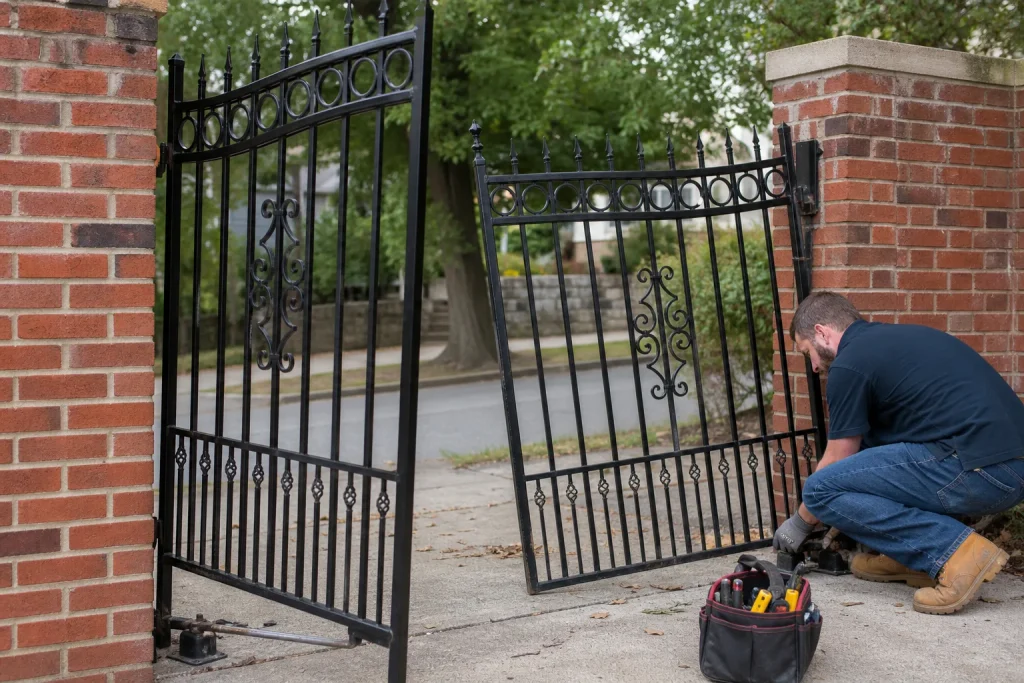
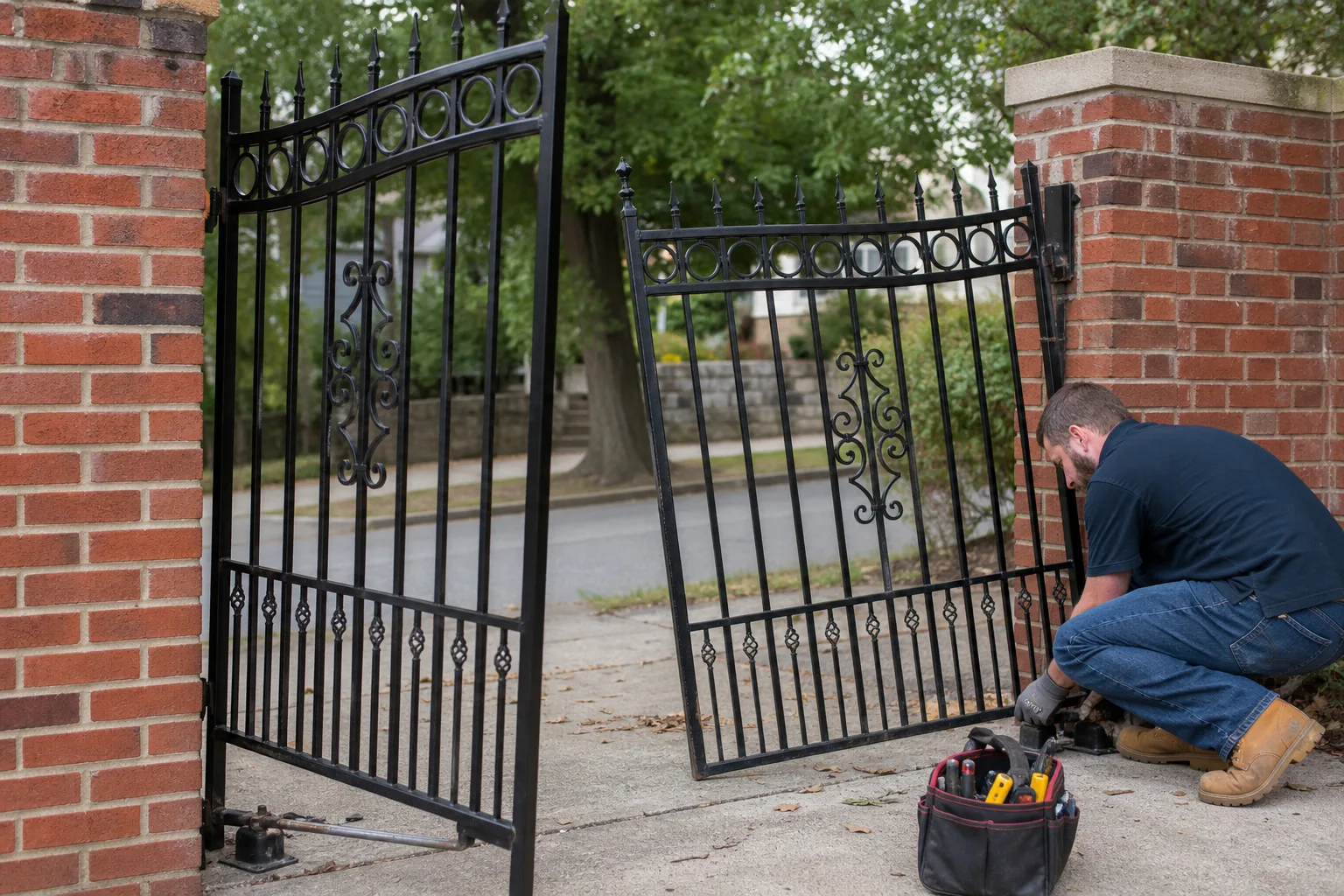
Emergency Gate Repair Near Me: What Philadelphia Homeowners Should Do First
If your automatic gate fails in Philadelphia, stop before you touch it. Disengage the operator using the correct manual release for your brand, secure your property with temporary measures that won’t create liability, then call a certified gate specialist who can explain their trip charge and after-hours rate before they dispatch. If you’d rather not handle any of this yourself, call Ironworks Gate Co. at (833) 624-0726 - a live person answers, 24 hours a day.
Here is the mistake we see most often. A homeowner in Chestnut Hill or Manayunk comes home to a gate stuck closed, needs to get a car inside, and forces it open by hand without releasing the operator clutch first. The gate moves six inches, something cracks, and now a $220 service call for a limit switch becomes a $900 operator replacement because the drive gear sheared clean off. That two-second decision is the difference between a quick fix and a major repair. The thirty minutes after a gate fails are when homeowners make choices that contain the problem or compound it. This guide slows that impulse down.
Step 1: Identify Your Operator Brand and Release It Correctly
Every automatic gate operator in Philadelphia has a manual release, but the location and method vary by brand. Using the wrong release sequence, or skipping the one step everyone forgets, is how drive gears get destroyed.
Here is how to disengage the six most common operators we encounter across Philadelphia’s residential neighborhoods:
- LiftMaster - Turn the manual release key (usually on the side of the housing) counterclockwise until you feel the clutch disengage. The gate should move freely by hand. The step everyone skips: turn the key back to the neutral position after moving the gate. Leaving it in release mode means the operator will not re-engage automatically when power returns, and the next cycle attempt will grind the internal gears.
- DoorKing - Lift the release lever on the motor housing until it locks in the up position. Move the gate manually. The skipped step: push the lever fully back down and verify it clicks into place. A half-seated lever causes partial engagement and gear chatter.
- Apollo / US Automatic - These share a similar worm-gear release: rotate the release knob on the motor face clockwise until resistance drops. The skipped step: count your rotations. Most need exactly three full turns to disengage and three to re-engage. Homeowners who guess often leave the worm gear in a stripped middle position.
- Viking - Pull the red manual release handle straight out from the operator body. It will stay extended when disengaged. The skipped step: push the handle in firmly until it is flush. Viking operators will attempt to run with a partially seated handle, and the resulting gear clash is expensive.
- Elite - Rotate the release cam on the motor shaft 90 degrees to the vertical position. The skipped step: return the cam to horizontal and confirm it locks with a slight detent click. Elite cams wear with age, and a sloppy re-engage in Philadelphia’s freeze-thaw cycles is a common failure point.
- FAAC - Use the release key provided with the unit, inserted in the side port and turned to the release icon. The skipped step: remove the key entirely before restoring power. FAAC systems can sense a key left in the port and fault into safe mode, requiring a technician reset.
If you cannot locate your release mechanism, or the gate still will not move after proper release, stop. Forcing it means something mechanical is binding - a bent track, seized hinge, or damaged roller - and continuing will bend it worse. This is when to call a pro.
When to call a pro: If the manual release does not free the gate, if you smell electrical burning, if the operator hums but does not move, or if the gate has come off its track. These are not homeowner fixes. A certified technician can diagnose whether the issue is mechanical, electrical, or in the control board. Gate Motor & Opener in Philadelphia covers what we check on every service call.
Step 2: Secure Your Property Without Creating Liability
A gate stuck open in Philadelphia is a security concern, especially in neighborhoods like Rittenhouse Square or along the Main Line where driveway gates are part of the property’s perimeter defense. But the wrong temporary fix can create liability that your homeowner’s insurance will not cover.
What works:
- Park a vehicle across the gate opening. It is visible, it blocks casual entry, and it creates no hazard.
- Temporarily chain the gate leaf to a fixed post using a padlock through existing hardware holes. Use chain with working load rating visible on the link stamp - not rope, not bungee cord.
- Activate any existing alarm or camera system and adjust notifications to maximum sensitivity for the night.
What creates liability:
- Blocking the sidewalk or alley with objects that impede pedestrian or emergency vehicle access. Philadelphia code enforcement can cite this, and your policy may exclude claims if an injury occurs.
- Stringing cable or wire across the opening at any height. A cyclist or delivery driver who does not see it at dusk creates an exposure your insurer will dispute.
- Removing the gate entirely and leaving sharp post stubs or exposed electrical conduit. We have seen this in West Philadelphia after a storm, and the resulting trip-and-fall claim exceeded the gate repair cost by tenfold.
If your gate is stuck open and you are unsure how to secure it safely, document the situation with photos and call your insurance agent’s after-hours line. Most Philadelphia-area homeowner policies have a duty-to-mitigate clause, and “reasonable temporary measures” is the standard. Ask what they consider reasonable, and follow it in writing.
Step 3: Vet the Emergency Repair Company Before They Dispatch
Not every company that advertises “24-hour gate repair” in Philadelphia is equipped to handle automatic operators. Many are general handyman services who will arrive, diagnose that the problem is beyond their tools, and still charge a full trip fee. Here is what to ask before you give an address.
What is your trip charge, and does it apply to the repair if I proceed? Some Philadelphia-area companies charge $150-$250 simply to show up after hours, then add hourly labor on top. Others roll the trip charge into the repair quote if you authorize work. Get this in writing, even if by text message.
What is your after-hours rate multiplier? Standard practice in Philadelphia is 1.5x labor rate for calls between 8 PM and 7 AM, and 2x on major holidays. A company that will not state this clearly is a company that will surprise you on the invoice.
Is your technician certified on my operator brand? If you have a LiftMaster, FAAC, BFT, or Linear system, ask specifically. A technician who says “we work on everything” without naming brands is likely learning on your dime. At Ironworks Gate Co., we are trained and equipped on nine automation brands - LiftMaster, FAAC, BFT, Linear, Viking, Ghost Controls, DoorKing, Elite, and Mighty Mule - so the correct fix is made on the first visit, whatever is on your driveway.
Can you provide a written quote before starting work? Verbal quotes in emergency situations are where $400 estimates become $900 bills. A legitimate company can diagnose and quote before turning a bolt. Our approach: no-hassle upfront pricing settled before a single bolt is turned - no surprises on the bill.
Do you guarantee your work in writing? Ask what happens if the same problem returns in two weeks. A verbal “we’ll take care of you” is not a guarantee. Our 90-Day Done Right Promise - the Keystone Standard - is written, with no paperwork and no arguing: if it is not right, we come back and make it right, every time, on every job.
Step 4: Know When “Emergency” Actually Means Emergency
Some gate failures in Philadelphia genuinely cannot wait. Others will cost you nothing extra if you wait until morning. Knowing the difference saves you the after-hours premium, which typically runs $200-$400 above standard rates in the Philadelphia market.
Genuinely call tonight:
- The gate is physically damaged and poses a collapse risk - a cracked weldnut on a cantilever gate, a gate leaf hanging by one hinge, or a bent track with the roller disengaged.
- The gate is stuck closed and blocks emergency vehicle access, or you have a medical situation requiring immediate egress.
- You smell burning electrical insulation or see arcing at the operator - this is a fire risk.
- The gate has damaged a vehicle or injured a person - document everything and secure the scene, but do not attempt repair.
Save the after-hours fee and call in the morning:
- The gate is stuck open but your property is otherwise secure, and you can park defensively for the night.
- The gate moves but stops short of full open or close - likely a limit switch or photocell alignment, neither of which worsens overnight.
- The remote or keypad stopped working but the manual release functions normally - this is almost always a programming or battery issue.
- The operator makes normal sounds but the gate does not move - probably a mechanical bind, which will not degrade further if left alone.
We have taken after-hours calls in Philadelphia where the homeowner simply needed to replace a remote battery. We made the trip, but we also told them how to avoid that charge next time. A square deal includes knowing when not to charge.
Red Flags: High-Pressure Tactics to Walk Away From
Emergency situations attract operators who profit from panic. In 42 years serving Philadelphia, we have heard the stories. Here is what to refuse.
Same-night upsell pressure. A technician who arrives at 10 PM and insists your operator is “about to fail completely” and must be replaced tonight, with a discount that expires when they leave. Real equipment failures show physical evidence - worn gears, cracked housings, burned boards. Ask to see it. A technician who “can’t show you” what failed is selling fear.
Verbal-only quotes with “we’ll figure it out.” Every repair has a diagnosable cause. If the technician cannot explain what failed and why in plain language, do not authorize work. Our technicians work in a customer’s home the way they would work in their own mother’s - that means explaining before acting.
No company markings, no uniform, no identification. Every Ironworks technician is background-checked and uniformed. If someone arrives in an unmarked van and will not produce ID tied to the company you called, do not grant access to your property.
Demand for cash or Zelle before work begins. Legitimate Philadelphia gate companies accept standard payment methods and invoice after completion. Upfront payment demands, especially for large amounts, are a hallmark of fly-by-night operators.
The Bottom Line
The thirty minutes after your gate fails are about restraint, not action. Release the operator correctly if you know how. Secure your property with measures that create no liability. Vet any emergency company with four specific questions about charges, rates, certification, and written guarantees. And know which failures genuinely cannot wait - most do not.
At Ironworks Gate Co. of Philadelphia home, we have been the company that makes a 40-year-old gate close like the day it was hung. We are trained and equipped on nine gate-automation brands, we answer live 24 hours a day, and we put every job in writing with our 90-Day Done Right Promise. If you are in Philadelphia and need help, call (833) 624-0726 for a free estimate. A live person will answer, and we will tell you honestly whether your situation needs tonight’s service or tomorrow’s.
Related services in Philadelphia: Gate Repair in Philadelphia | Gate Installation in Philadelphia
Frequently Asked Questions
Emergency gate repair in Philadelphia typically ranges from $280 for a simple limit switch or photocell adjustment to $850-$1,400 for operator replacement, with after-hours trip charges adding $200-$400 to standard rates. Most common repairs - hinge welding, roller replacement, control board resets - fall between $350 and $650 during business hours. Call (833) 624-0726 for an exact quote - estimates are free, and we will tell you if waiting until morning saves the after-hours premium.
You can move most gates manually if you first disengage the operator clutch using the correct manual release for your brand - LiftMaster, DoorKing, Viking, and others each have specific procedures. Skipping the release step and forcing the gate by hand will shear internal gears in under two seconds, turning a minor repair into a full operator replacement. If you cannot locate your release mechanism or the gate still will not move after release, stop and call a certified technician.
For gates under 25 years old in Philadelphia, repair is almost always the economical choice - a new residential automatic gate installation starts around $4,500-$8,500 including operator, while most repairs run under $800. Replacement becomes sensible when the gate frame has structural rot or rust-through, the posts are failing at grade, or repair costs exceed 60% of replacement. We offer free second opinions on any written estimate to help you decide.
True emergency response in Philadelphia varies by company and time of day. At Ironworks Gate Co., a live person answers every call 24 hours a day, and we dispatch based on urgency - same-day for genuine emergencies, next-business-day for non-critical issues. Most jobs are completed in a single visit because our technicians arrive trained on your specific operator brand and equipped with common parts. Call (833) 624-0726 to discuss your timeline - we will be there when we say.
Written by the team at Ironworks Gate Co. of Philadelphia, serving Philadelphia since 2012.
Need Gate Repair Help?
Call Ironworks Gate Co. of Philadelphia - licensed & insured, here with fast after-hours help in Philadelphia.
(833) 624-0726